work hub

2021-2024

Innovating Investment Tracking: Turning Every Decision into Valuable Insights

Portfolio managers make high-stakes decisions daily, with impacts measured in billions. Traditionally, they’ve tracked their investment behavior using inconsistent methods like notebooks and binders, leading to unstandardized data.

The Investment Journal module transforms this process by offering intuitive tools to evaluate past investments, identify decision patterns, and optimize future strategies. Its integrated email authorization response system streamlines workflows, adding minimal effort while providing deeper insights into decision-making processes.

As a result, 85% of portfolio managers adopted decision logging practices, leaving positive feedback as they transitioned from spreadsheets and notebooks to a more secure and streamlined solution that improved data accuracy and provided valuable insights for optimizing strategies.

01

investment journal

The Journey Begins

I.

OBJECTIVES

The company aimed to achieve the following objectives for the MVP release, listed in order of priority:

Expansion Requirements

The system needed to accommodate rapid expansion without excessive manual intervention.

Time Constraints

Lengthy setup times were no longer viable in a competitive, fast-paced market.

Diverse Needs

Hotels, restaurants, and event venues required vastly different features, such as loyalty programs, reservation management, and event promotion tools.

Customization Complexity

Businesses lacked the technical expertise to reflect their unique brand identity in their digital experiences.

The wireframe represents the company’s early vision of the Investment Journal, which became the starting point for its development.

Before reaching out to us with this project, the company attempted to collect authorization comments in the authorization details by sending an email with an internal link to investment specialists after processing each order. However, this approach was largely ignored due to its complexity and lack of user-friendliness for the specialists.

II.

challenges

Investment specialists faced several key challenges that hindered their ability to work efficiently. Their existing workflows were fragmented, relying on spreadsheets, email threads, and disconnected tools. This led to:

Scattered Information

Historical data was not centralized, making analysis cumbersome.

Manual Workflows

Logging and reviewing decisions was time-consuming.

Lack of Insights

There was no easy way to identify decision patterns or learn from past outcomes.

Low Engagement in Logging

Logging and reviewing decisions was time-consuming.

While these challenges were clear, as designer, I faced a major limitation: lack of direct communication with the users. Instead of engaging with specialists directly, I had to rely on second-hand insights from cross-team communication and pre-existing research. This made it difficult to fully validate our assumptions.

III.

my role

As a designer, I solve complex user challenges by crafting intuitive, impactful digital solutions. I advocate for users by transforming their needs into streamlined workflows and clear, functional interfaces. Although I don't have direct user communication, I collaborate closely with cross-functional teams to integrate research, insights, and feedback into every stage of the design process. By balancing creativity and strategy, I deliver scalable solutions that drive business value, focusing on simplifying complexity and enhancing usability to empower users to achieve their goals effortlessly.

IV.

approach

Given the complexity of the project and the lack of direct communication with real users, I relied heavily on insights provided by cross-team collaboration, user research, and existing testing results. To bridge this gap, I adopted an iterative design process, ensuring that solutions evolved based on continuous feedback and validation from available data.The process involved multiple design sprints, allowing me to refine and optimize features incrementally. Starting with wireframes and brainstorming sessions, I combined the team’s research findings with my understanding of investment specialists’ routines.Collaboration was critical. I worked closely with product managers and engineers to ensure that my solutions were technically feasible and aligned with the product’s goals. Regular feedback loops helped me address potential issues early, particularly with data integration and visualization. These loops also allowed me to refine assumptions in the absence of direct user input.Despite the communication constraints, this iterative and collaborative approach ensured that the final design addressed core user pain points while remaining practical and aligned with the project’s vision.

preface

02

investment journal

shaping the vision

I.

key users

Portfolio Managers (Equity Unit)

Portfolio Managers are finance professionals who develop and manage investment strategies, ensuring portfolios align with client goals and adapt to changing market conditions. Typically overseeing portfolios of 50–80 companies, they manage an annual turnover of 20–30%, equating to the addition of 10–24 new companies each year. To achieve this, Portfolio Managers continually analyze and monitor around 200 potential companies to stay informed, identify opportunities, and optimize investment outcomes.

Analysts  (Equity Unit)

Investment Analysts are financial experts who evaluate market trends, economic data, and company performance to provide actionable investment recommendations. They manage focused portfolios of 7–10 companies while monitoring 40–50, allowing them to develop deep expertise in high-potential opportunities. Their detailed research and insights play a key role in guiding strategic decisions and supporting Portfolio Managers.

II.

User journey map

Next, I conducted a User Journey Map to gain a deeper understanding of how this module would be used and to align with the team, ensuring I accurately captured the pain points of investment specialists.

III.

Needs

An easy, quick way to log decisions.

Centralized access to historical data.

Insights to learn from past performance.

Integration with existing tools to reduce manual effort.

IV.

Job stories

Reflecting on Past Performance

When reviewing past outcomes, I want to see visual comparisons, so I can quickly identify successes and mistakes.
When analyzing data, I want to customize metrics, so I can focus on what matters most.
When reviewing trends, I want to filter by relevant factors, so I can uncover patterns to improve future decisions.

Capturing Recurring Work

When logging repeated tasks, I want pre-filled templates, so I can save time and maintain consistency.
When documenting, I want automatic tagging and structure, so I can easily find and organize information.
When searching past records, I want everything stored in one place, so I can quickly access what I need.

When tracking performance, I want automatic data capture, so I can focus on the work without worrying about documentation.
When I need quick updates, I want automatic insights, so I can stay informed with minimal effort.
When reviewing progress, I want fast access to key data, so I can spot what needs attention immediately.

Staying on Top of What Matters

research

03

investment journal

Form meets function

vision

Idea

To empower PMs and Analysts with intuitive, accurate, and interactive tools that streamline authorizations, enhance decision analysis, and enable actionable insights. By addressing pain points like inefficiency, manual processes, and limited data interactivity, the product aims to transform complex workflows into seamless experiences. It will provide robust visualization, customizable metrics, and interactive features, ensuring users can make confident, data-driven decisions efficiently.

I.

Centralized Data Hub with Customization

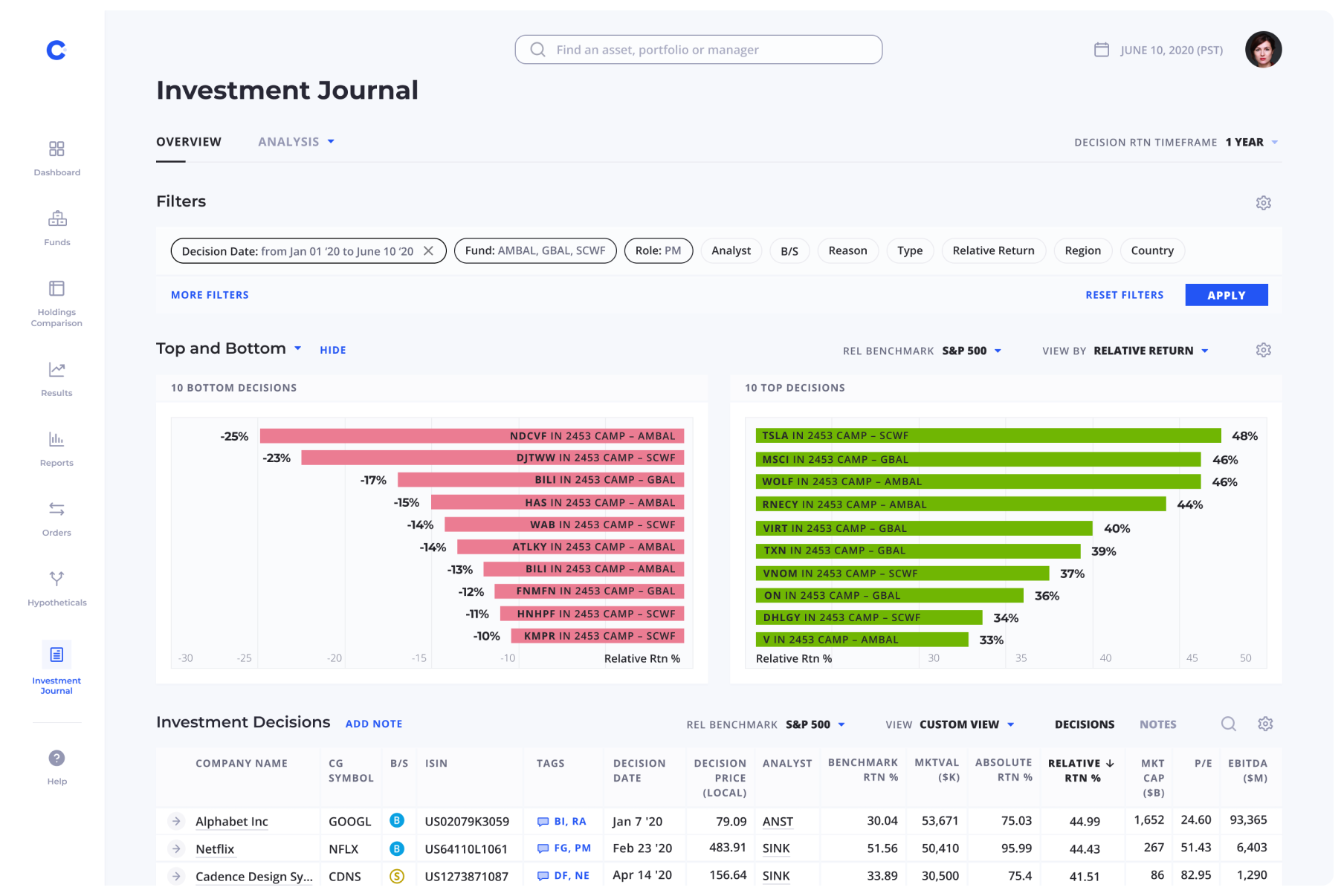
A comprehensive and structured repository of past decisions, designed to provide investment professionals with seamless access to critical information. Users can easily search, filter, and explore data based on specific criteria, empowering them to quickly retrieve relevant insights.

Key features include:
• Customizable Views: Tailor data presentation with personalized sorting preferences, tags, and layouts to align with individual workflows and priorities.
• Deep Decision Exploration: Dive into the details of any decision, uncovering its preconditions, outcomes, and associated notes for a thorough understanding.

This hub serves as a dynamic tool to enhance decision-making efficiency, encourage proactive analysis, and provide a foundation for strategic insights tailored to the needs of each user.

II.

Automation & Simplified Logging

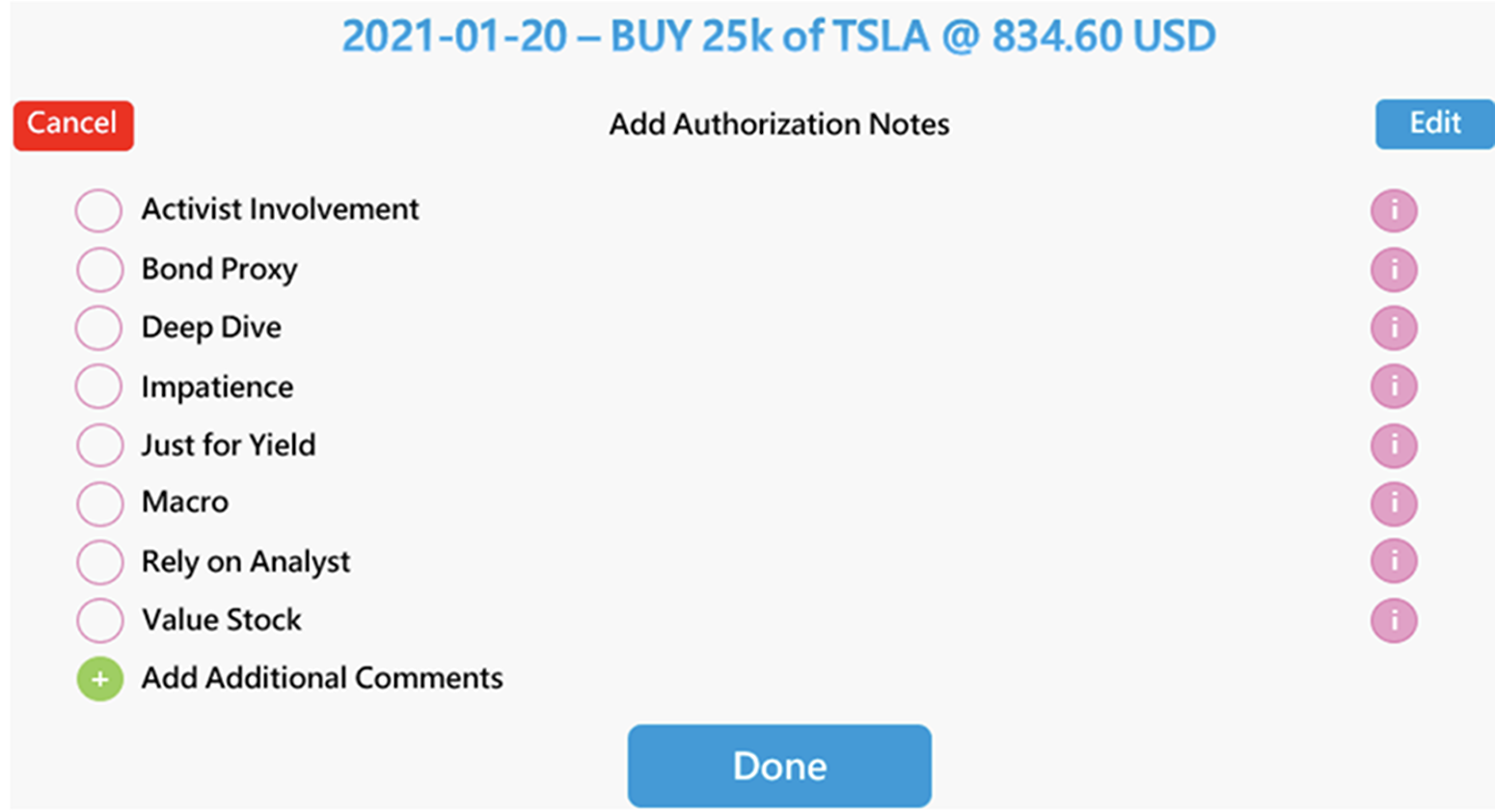
We introduced an email notification system triggered after each completed order, encouraging investment specialists to provide immediate input. By clicking a button in the email, users are directed to a pop-up with AI-generated, pre-filled suggestions, which they can either confirm or modify. To tailor its suggestions, the AI requires users to complete a one-time survey by labeling 10 prior decisions, helping it learn their decision-making patterns.

III.

Dynamic Insights

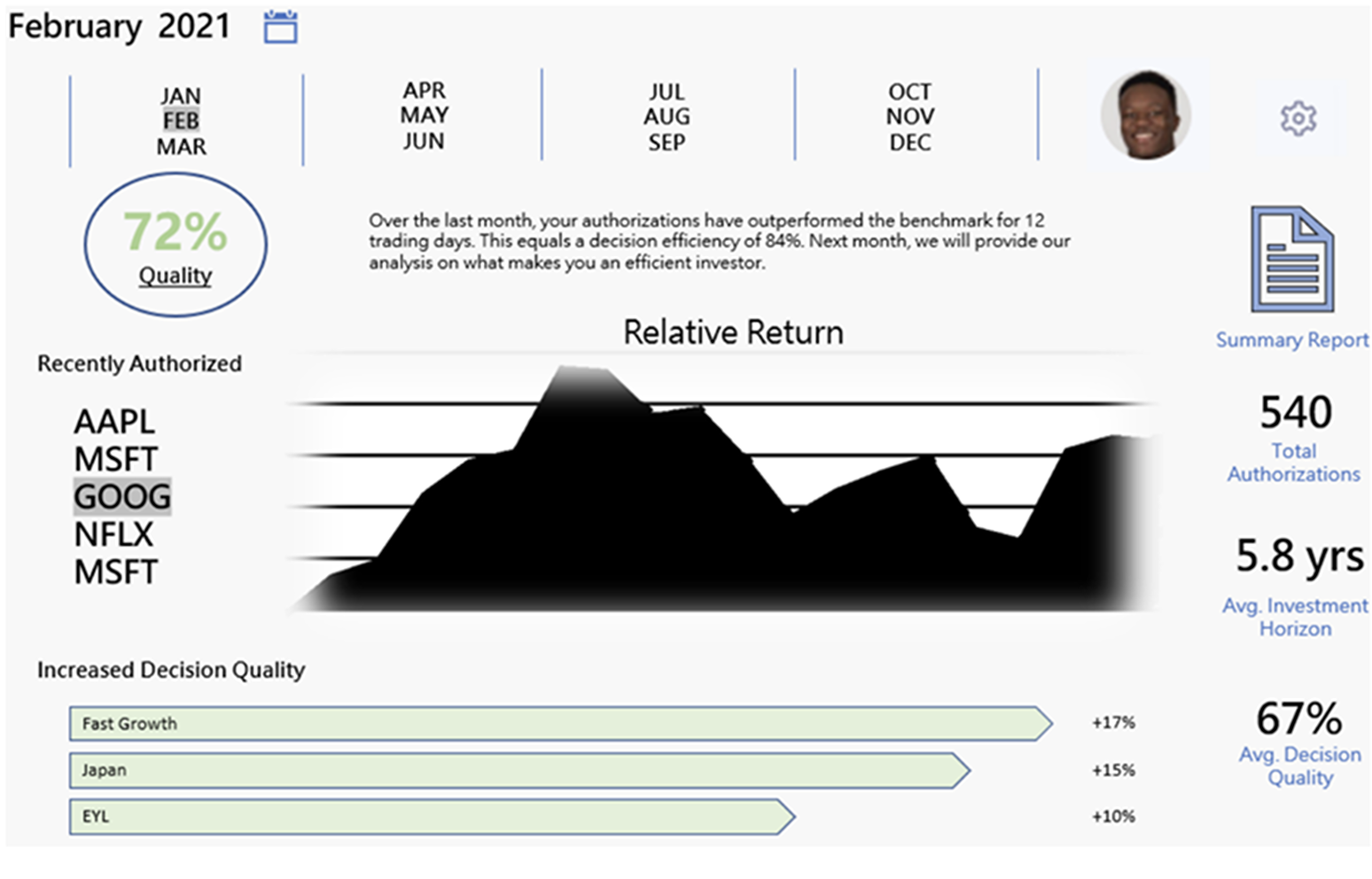
Empower users to evaluate their performance with tailored metrics and visualizations that provide clear context, aligning with their unique investing styles.

Key features include:
• Performance Overview: Offers users a high-level snapshot of key metrics, categorizing investment results by type and reason. This enables quick assessment of overall portfolio performance.
• Actionable Insights: Displays essential KPIs for users to immediately understand trends, providing clarity on performance impacts and trends that matter most.
• Customizable Visualizations in separate Analysis tab: Tailored charts and metrics allow users to adjust filters, metrics, and chart types, focusing on what’s important for their unique strategies. Facilitates tracking of long-term investment trends, helping users identify patterns, measure progress, and refine strategies with actionable insights.

05

investment journal

Refining the Path

Revision

post-testing insights

To better align the Investment Journal with the needs of investment specialists, the company organized a testing session with a small group of investment specialists. Feedback was transcribed and analyzed, below are the key findings and solutions implemented:

I.

Capturing Not Made Decisions

Finding:
Initial designs excluded unexecuted orders and non-made decisions from the journaling process. However, feedback revealed that these omissions left a gap in the decision-making record.

Solution:
I added a dedicated Notes Tab to document unexecuted orders, predictions, and non-made decisions. Users can log attributes such as the date, conviction level, and free-form notes, along with an optional “Type” field for categorization.

Outcome:
The introduction of the Notes Tab has significantly enhanced the satisfaction of investment specialists, particularly analysts, by enabling comprehensive documentation of unexecuted orders and non-made decisions. This feature received exceptional reviews during testing and quickly became a critical functionality for the module. Its success prompted further improvements, ensuring it continues to meet user needs and remains a cornerstone for detailed decision analysis and future strategy development.

II.

Optimizing Email Notification Frequency

Finding:
High volumes of order-based email notifications were overwhelming users, leading to notification fatigue. Users expressed a need for more control over the frequency of these notifications to avoid unnecessary distractions.

Solution:
I added customizable notification frequency settings, allowing users to choose how often they receive updates (daily, weekly, or per occurrence).

Outcome:
The rate of filled decisions increased sharply as users were better able to stay on top of their tasks without feeling overwhelmed.

III.

Refining Decision Quality Metrics

Finding: Investment specialists raised concerns about accurately estimating decision quality. The best-and-worst decision charts lacked clarity, particularly in scenarios like asset sales where long-term outcomes could differ from initial gains.

Solution:
I redesigned the best-and-worst decision charts to focus on performance within defined timeframes, providing clearer insights and resolving confusion about how to evaluate decision outcomes.

Outcome:
These changes significantly improved the platform's ability to estimate decision quality. Users now have a clearer understanding of decision impacts, greater trust in the platform's insights, and improved accountability.

IV.

Improving Engagement with Decision Completion

Finding: Incomplete orders significantly reduced the system's effectiveness. Investment specialists found the process of backfilling decisions tedious, resulting in low engagement and critical data gaps.

Solution:
To address this issue, I introduced a completion strategy featuring:
• A banner displaying the ratio of completed vs. pending decisions, paired with a call-to-action (CTA) encouraging users to complete them within 15 minutes.
• A streamlined tagging page accessed via the CTA, where users could efficiently complete entries using AI-driven suggestions. This approach prioritized simplicity by focusing on primary decision types and reasons.

Outcome:
This strategy improved engagement and completion rates by reducing friction in the decision journaling process. The clear prompts and AI-driven assistance empowered users to maintain data accuracy while significantly increasing system effectiveness.

06

investment journal

Driving Impact

results

After the feature launch, 85% of Portfolio Managers adopted the decision log feature, resulting in a 60% increase in the number of completed logs within the PM group.

This significant improvement helped PMs form the habit of regularly using the feature, which in turn enhanced decision tracking and data accuracy. Additionally, the integration completion rate showed strong results, with most PMs actively logging past decisions, providing a more reliable foundation for performance analysis.

Although analysts had fewer decisions to log, they still found value in the note-taking feature of the Investment Journal, leading to a 25% adoption rate among them. This engagement highlighted the need for a more tailored approach for analysts, who typically handle fewer decisions. Insights from this will drive future improvements to better serve their needs.

The overall active user rate remained strong, with 85% of PMs consistently using the logging tools to track and refine their strategies. The satisfaction rate was also high, with many users expressing satisfaction with the customization options and advanced features. These engagement metrics demonstrate how the feature is improving decision-making and supporting better investment outcomes.
07

investment journal

to be continued...

what's next

The Investment Journal module's positive reviews, along with worker suggestions and belief in its potential, led to the creation of a dedicated team. Upcoming plans include:

Future plans include:
• Machine learning analytics to assess decision contributions.
• New IJ API for integrating personalized insights and decision analytics (QRA, Cabot).
• Proactive behavior signals to improve strategies across platforms.
• Enhanced data integration and migration of legacy systems for seamless decision capture and better data flow.
• A new UI for customizing IJ based on user preferences.

These updates will refine decision-making and user experience, with key improvements expected by Q1 2026.